Choosing a career is only the beginning. The next challenge is becoming good enough at the work that employers, clients or customers have a reason to choose you.
A career goal gives you a destination. Skills give you a way to get there.
But building career skills is not simply a matter of collecting certificates, watching online courses or adding more qualifications to your résumé. The most effective approach is to understand what your target career actually requires, identify where you currently stand, close the most important gaps, and build evidence that you can apply what you have learned.
That distinction matters in a changing labour market.
The World Economic Forum’s Future of Jobs Report 2025, based on responses from more than 1,000 employers representing over 14 million workers across 55 economies, estimates that about 39% of workers’ existing skill sets could be transformed or become outdated by 2030. It also found that 63% of employers surveyed see skills gaps as a major barrier to business transformation.
At the same time, employers continue to value both technical and human capabilities. The WEF identifies analytical thinking, resilience, flexibility and agility, leadership and social influence, creative thinking, technological literacy, and curiosity and lifelong learning among the important skills shaping the future workforce. (World Economic Forum)
So the question isn’t simply:
“What qualification should I get?”
A better question is:
“What capabilities do I need to become valuable in the career I want—and how can I prove that I have them?”
That is the approach we take at CareerWorkGuide.
1. Identify the Skills Your Target Career Requires
Before you start learning anything, identify what you actually need to learn. This sounds obvious, but it is one of the easiest steps to skip.
Many people begin with a course. They see an advertisement for a certification, an online bootcamp or a university program and immediately think:
“This could help my career.”
Maybe it will.
But you should first work backwards from the target role.
Start with:
Target career → Target job → Required skills → Current abilities → Skill gaps → Learning plan
For example, imagine you want to become a data analyst.
Don’t begin by asking:
“Which data analytics course should I buy?”
Begin with:
“What do employers hiring data analysts actually expect?”
You might discover that relevant roles commonly involve skills such as data analysis, spreadsheets, SQL, data visualization, communication and problem-solving.
You can then compare those requirements with your current abilities.
This approach is consistent with guidance from Canada’s Job Bank, which recommends identifying the skills and knowledge required for a desired job and then comparing those requirements with your own skill set before deciding whether you need to upskill or reskill.
For U.S. readers, CareerOneStop provides occupation profiles containing information such as wages, employment trends and skills, along with tools including the Skills Matcher and Work Values Matcher.
Where Should You Look for Required Skills?
Use several sources rather than relying on a single course provider.
Look at:
- Government occupational profiles
- Professional associations
- Current job descriptions
- Employer career pages
- Experienced professionals
- Apprenticeship and training programs
- Industry publications
- Reputable education providers
Job advertisements are particularly useful because they show what employers are requesting now, rather than what a generic career article says employers might want.
Look for patterns.
If ten relevant job advertisements repeatedly mention the same capability, that is a signal worth investigating.
2. Separate Technical Skills From Transferable Skills
Not every skill serves the same purpose. A useful starting point is to distinguish between technical or job-specific skills and transferable skills.
Technical Skills
These are capabilities closely connected to a particular occupation or type of work.
Examples include:
- Programming
- Financial modelling
- Accounting
- Data analysis
- Welding
- Graphic design
- Cybersecurity
- CAD
- Project-management software
- Medical procedures
- Digital marketing analytics
They tend to be more directly connected to particular jobs.
Canada’s Job Bank describes hard skills as work-specific skills that can be tied to a role or industry and may be acquired through institutional learning or on-the-job experience.
Transferable Skills
These are capabilities that can be useful across multiple occupations.
Examples include:
- Communication
- Problem-solving
- Adaptability
- Teamwork
- Critical thinking
- Organization
- Leadership
- Creativity
- Customer service
Canada’s Skills for Success framework similarly identifies foundational skills such as communication, problem solving, adaptability and digital literacy as useful across work and everyday life. (Job Bank)
The distinction is important because you generally need both.
A software developer needs programming knowledge, but also needs to communicate with colleagues, understand requirements and solve problems.
A project manager needs project-management knowledge, but also needs communication, organization, leadership and judgment.
A marketing professional needs marketing tools and techniques, but also needs creativity, analysis and communication.
The strongest career profiles are rarely built from technical skills alone.
3. Find Your Skill Gaps
Once you know what your target career requires, compare that list with what you can already do.
This is where CareerWorkGuide’s simple Current Skills → Required Skills → Gap framework becomes useful.
Step 1: List Your Current Skills
Don’t underestimate skills you already have.
Your current experience may have given you abilities that transfer into your next career.
For example, someone working in customer service may already have:
- Communication
- Conflict resolution
- Customer relationship skills
- Problem-solving
- Time management
- Product knowledge
Someone moving into project coordination might already possess several useful capabilities—even if their current job title has nothing to do with project management.
CareerOneStop’s tools are designed around this principle: users can assess their skills and explore occupations that use those capabilities. Its career-transition resources also encourage people to identify transferable skills when changing occupations or industries. (CareerOneStop)
Step 2: List the Skills Your Target Role Requires
Use your research from job advertisements, occupational profiles and professional sources.
Separate:
Essential skills
from
Helpful or preferred skills.
Don’t treat every item in a job description as equally important.
Step 3: Identify the Gap
You might end up with something like:
| Skill | Current level | Target level | Gap |
| Excel | Intermediate | Advanced | Moderate |
| SQL | Beginner | Intermediate | Significant |
| Data visualization | Beginner | Intermediate | Significant |
| Communication | Advanced | Advanced | Small |
| Problem-solving | Intermediate | Advanced | Moderate |
Now you have something much more useful than: “I need to become a data analyst.”
You have a development map.
Upskilling vs. Reskilling
The size of your gap can also help you determine whether you are upskilling or reskilling.
Upskilling generally means strengthening or expanding capabilities within your current field.
Reskilling means developing a substantially different set of skills to move into a new occupation or area.
Canada’s Job Bank specifically uses this distinction when helping workers compare their existing skill sets with the requirements of a desired career. (Job Bank)
The difference matters because a small skill gap might require a short course or workplace project.
A major career transition may require much more substantial education, training and experience.
4. Which Skills Should You Learn First?
Once you have identified your gaps, don’t try to learn everything simultaneously.
Prioritize.
A useful way to organize your skills is into four categories.
High-Value Skills
These are capabilities that are strongly connected to your target role and can materially improve your ability to perform valuable work. Their exact nature varies by career.
For example, programming may be central to a software role, while financial analysis may be central to a financial analyst role.
Foundational Skills
These are capabilities that support many other skills.
Examples include:
- Communication
- Numeracy
- Digital literacy
- Research
- Problem-solving
- Analytical thinking
- Writing
They may not sound glamorous, but weaknesses in foundational skills can make more advanced learning difficult.
Job-Specific Skills
These are the capabilities most directly associated with performing the target role.
You should usually prioritize these when preparing for a specific job.
Transferable Skills
These help you move between roles, teams and industries.
They become particularly valuable when you change careers or when the labour market changes.
The World Economic Forum’s 2025 research reinforces the importance of combining technical capabilities with human skills. AI and big data, networks and cybersecurity, and technological literacy are among the fastest-growing skills, while analytical thinking, creative thinking, resilience, flexibility, agility and leadership also remain important. (World Economic Forum)
A Better Rule for Prioritizing Skills
Ask four questions:
- Is this skill required for my target role?
- How frequently do employers request it?
- How difficult would it be to replace or automate?
- Will this skill remain useful in other roles?
The answers can help you decide what deserves your time first. And don’t blindly chase whatever skill is currently trending.
A skill is valuable to you when it connects to a realistic career opportunity.
5. Do You Need a Degree?
This is one of the biggest questions people face when planning a career.
And the honest answer is:
Sometimes yes. Sometimes no.
The mistake is treating “degree” as either universally necessary or universally unnecessary.
The appropriate education depends on the occupation.
Some professions have formal educational, licensing or regulatory requirements. Others can be entered through vocational education, apprenticeships, industry certifications, portfolios, work experience or combinations of these pathways.
The U.S. Bureau of Labor Statistics includes typical entry-level education, related work experience and on-the-job training in its occupational profiles, illustrating how entry requirements vary considerably between occupations. (Job Bank)
Canada’s Job Bank similarly shows that occupations can require different combinations of university degrees, college diplomas, apprenticeships, secondary education and on-the-job training. (Job Bank)
The UK government also provides several routes beyond traditional university study, including apprenticeships, higher technical qualifications and vocational technical qualifications. (Skills for Careers)
So instead of asking: “Do I need a degree?”
ask:
“What does this particular career require, and which pathway gives me the best way to meet those requirements?”
When a Degree Makes Sense
A degree may be appropriate when:
- The occupation requires one.
- It is the standard pathway into the profession.
- It provides essential theoretical knowledge.
- It is required for progression.
- It provides access to regulated professional practice.
- The programme offers valuable practical experience and employer connections.
When Another Path May Make More Sense
Alternative pathways can be appropriate when:
- The occupation doesn’t require a degree.
- Practical skills are more important than academic credentials.
- An apprenticeship provides a strong entry route.
- A recognized vocational qualification is sufficient.
- You can demonstrate competence through projects and experience.
- A shorter training route can efficiently close your skill gap.
The goal isn’t to avoid education.
The goal is to choose the education that actually serves your career.
6. When Is a Certification Worth It?
Certifications can be valuable. But not every certification is valuable. This distinction is critical.
A certificate of course completion might simply show that you finished a learning program.
A professional certification may involve a defined body of knowledge, an assessment, eligibility requirements or an industry-recognized credential. Those aren’t necessarily equivalent.
Before paying for a certification, ask:
Is it actually required?
Some occupations require licenses or formal credentials. If the credential is legally or professionally necessary, its value is obvious.
Do employers actually recognize it?
Search current job advertisements. Look for the certification by name.
If employers repeatedly request or prefer it, that’s useful evidence.
Does it validate a skill you can demonstrate?
A credential is more useful when it complements actual ability.
Does it help you enter the occupation?
If it has little connection to hiring decisions, its value may be limited.
What is the total cost?
Consider:
- Tuition
- Exam fees
- Renewal fees
- Study materials
- Time
- Travel
- Opportunity cost
Can you demonstrate the same capability another way?
Sometimes a portfolio project, work experience or apprenticeship may provide stronger evidence of practical competence.
Don’t collect certifications. Build capabilities.
The certification should support that goal.
7. Courses vs. Certifications vs. Degrees vs. Experience
There is no universal winner. Each pathway solves a different problem.
| Path | Best for | Main strength | Main limitation |
| Degree | Formal professions, deep academic foundations | Broad education and recognized qualification | Often requires substantial time and money |
| Certification | Specific professional or technical competencies | Focused credential | Value varies significantly by industry |
| Short course | Targeted skill development | Fast and focused | May not carry much hiring weight alone |
| Apprenticeship | Practical, occupation-specific training | Earn while gaining real work experience | Availability varies by occupation and location |
| Projects | Demonstrating practical ability | Creates evidence of what you can actually do | May not replace formal requirements |
| Work experience | Almost every career | Builds judgment, context and credibility | Can be difficult to obtain without initial skills |
Apprenticeships are particularly interesting because they combine learning with employment.
In the United States, Registered Apprenticeships provide paid work experience, structured on-the-job learning, mentorship, classroom instruction and a portable credential. (Apprenticeship.gov)
In England, apprenticeships are real jobs where apprentices earn a wage while learning, with substantial on-the-job training and a qualification at the end. (Skills for Careers)
The important lesson is that learning doesn’t have to happen in only one environment.
You can learn in a classroom.
You can learn online.
You can learn at work.
You can learn through an apprenticeship.
You can learn by building something.
The best pathway may combine several of these.
8. How to Learn Skills Without Going Back to College
Going back to university is not the only way to develop career skills. Depending on your target occupation, you may be able to combine several learning methods.
Online Courses
Online learning can be useful for acquiring specific knowledge and structured skills. But choose courses based on your target role—not simply popularity.
Before enrolling, check:
- Who teaches it?
- What will you actually learn?
- Is the curriculum current?
- Does it include practical work?
- What evidence will you have at the end?
- Is it recognized by employers?
Practical Projects
Projects convert knowledge into application.
Instead of only watching someone explain data analysis, analyze a real dataset.
Instead of only studying web development, build a website.
Instead of only studying marketing, create a campaign strategy.
Projects force you to solve problems rather than simply recognize answers.
Deliberate Practice
Skill development requires practice.
Don’t just consume information.
Do the work.
Write.
Code.
Analyze.
Design.
Present.
Build.
Repair.
Calculate.
Sell.
Teach.
Whatever your field requires, practice the underlying activity repeatedly.
Communities and Professional Networks
Communities can expose you to:
- Industry discussions
- Experienced professionals
- Feedback
- Mentors
- Job opportunities
- Emerging tools
- Common workplace problems
Canada’s Job Bank explicitly includes networking and staying connected to an industry as part of career development, particularly because professional networks can help workers discover opportunities and mentors. (Job Bank)
Mentoring
A mentor can help you identify mistakes that would otherwise take months or years to discover. Look for someone who has practical experience in the type of work you want to do.
Don’t approach mentoring simply as:
“Can you get me a job?”
A better question is:
“What should I learn and practice to become competitive for this type of role?”
Apprenticeships and Work-Based Learning
When available, these can be powerful because they connect training directly with real work.
U.S. Registered Apprenticeships, for example, combine paid employment, structured on-the-job learning, mentorship, classroom instruction and an industry-recognized credential. (Apprenticeship.gov)
England’s apprenticeship system similarly combines paid employment with structured learning and occupational training. (Skills for Careers)
Employer Training
Don’t overlook your current employer. Many people assume career development requires leaving their job. Sometimes the best learning opportunity is already inside it.
Ask whether you can:
- Join a new project
- Shadow another team
- Take responsibility for a new task
- Use a new tool
- Attend internal training
- Work with a more experienced colleague
- Take on stretch assignments
You can often build new capabilities while continuing to earn an income.
9. Build Evidence of Your Skills
One of the biggest mistakes in skills development is stopping at learning. You don’t simply need to know something. You need to be able to show what you can do.
Consider the difference between these two statements:
“I completed a course in data analytics.”
and:
“I analyzed a public dataset, identified three trends, built a dashboard and presented the findings.”
The second statement provides evidence of application.
Build a Portfolio
A portfolio can include:
- Projects
- Case studies
- Designs
- Writing samples
- Data analyses
- Code
- Presentations
- Research
- Campaigns
- Business plans
- Before-and-after examples
Not every career needs a traditional portfolio.
But almost every career can benefit from evidence of competence.
Use Projects to Tell a Story
Don’t simply upload a finished project.
Explain:
Problem → Approach → Skills Used → Result → What You Learned
This makes your work easier for an employer or client to understand.
Document Achievements at Work
If you’re already employed, your evidence doesn’t have to be public.
Keep track of:
- Problems you solved
- Projects you completed
- Processes you improved
- Revenue you influenced
- Costs you reduced
- Customers you helped
- Systems you introduced
- Teams you supported
These examples can later strengthen your résumé and interview answers.
Certifications Are Evidence—But Not the Whole Story
A recognized certification can demonstrate that you’ve met a defined standard or completed an assessment. But it doesn’t automatically prove that you can perform every task associated with a job.
That’s why the strongest profile often combines:
Credential + Skill + Practice + Evidence + Experience
10. Create Your Personal Skills Development Plan
Now turn everything you’ve learned into an actionable plan.
Use this CareerWorkGuide framework:
Target Role → Required Skills → Current Level → Learning Resource → Practice → Evidence → Application
1. Target Role
Choose a specific role.
Not simply:
“I want to work in technology.”
Instead:
“I want to qualify for entry-level data analyst roles.”
2. Required Skills
Identify the skills employers and reliable occupational sources associate with that role.
3. Current Level
Rate yourself honestly.
For example:
- Beginner
- Basic
- Intermediate
- Advanced
Avoid rating yourself based on confidence. Rate yourself based on what you can actually demonstrate.
4. Learning Resource
Choose the most appropriate method:
- Degree
- Certification
- Course
- Apprenticeship
- Mentoring
- Workplace training
- Self-directed learning
5. Practice
Use exercises and real projects.
6. Evidence
Create something that demonstrates your ability.
7. Application
Use the new capability in:
- Your current job
- Freelance work
- Volunteer work
- Internship
- Apprenticeship
- Portfolio project
- Job applications
A simple planning table could look like this:
| Target skill | Current level | Target level | Learning method | Evidence | Deadline |
| Excel | Intermediate | Advanced | Course + projects | Analysis project | 30 days |
| SQL | Beginner | Intermediate | Course + practice | SQL portfolio project | 60 days |
| Data visualization | Beginner | Intermediate | Guided project | Dashboard | 75 days |
| Communication | Intermediate | Advanced | Presentations + feedback | Recorded presentation | 90 days |
The important thing isn’t the exact format.
It’s the progression.
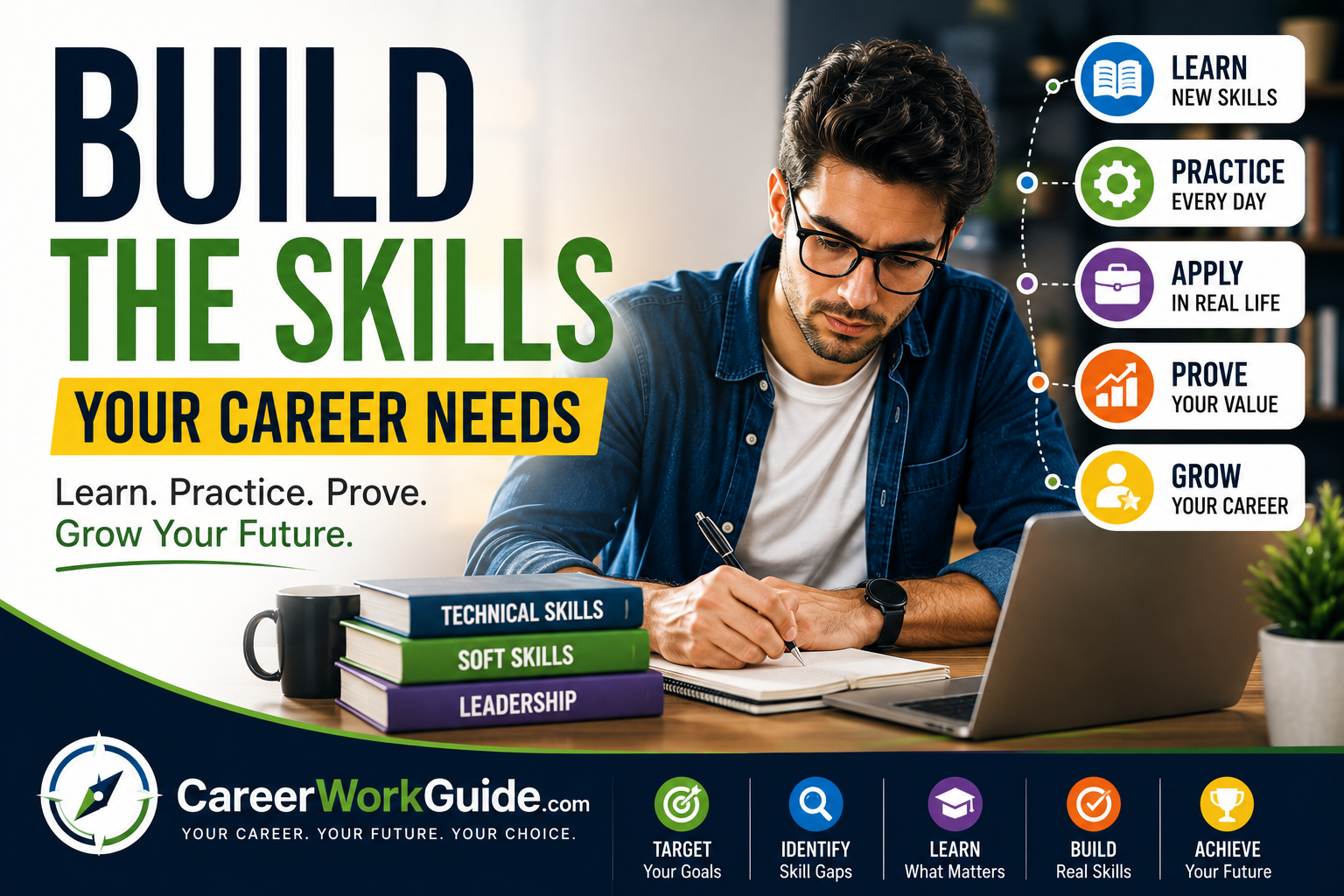
Learn → Practice → Demonstrate → Apply.
Don’t Try to Learn Everything at Once
One of the biggest problems with online career advice is the endless list of things you’re supposedly required to learn.
You can quickly end up with:
Excel + Python + AI + SQL + public speaking + project management + cybersecurity + digital marketing + leadership + networking + six certifications…
That’s not a career plan.
That’s a recipe for overwhelm.
Instead, identify the smallest useful skill set that can move you toward your next opportunity.
Then build from there.
A useful progression is:
Stage 1 — Essential
What must I know to perform the role?
Stage 2 — Employable
What skills would make me competitive for entry-level opportunities?
Stage 3 — Valuable
What capabilities would help me perform particularly well?
Stage 4 — Advanced
What could eventually differentiate me from other professionals?
This keeps learning connected to an actual career objective.
Build Skills That Can Survive Change
A career skill should not only help you get today’s job. Ideally, it should help you remain useful as the nature of work changes.
The World Economic Forum expects technological change, AI, green-transition pressures, demographic shifts and other factors to reshape jobs and skills through 2030. Its 2025 report identifies AI and big data, networks and cybersecurity, and technological literacy among the fastest-growing skill areas, while also highlighting analytical thinking, creative thinking, resilience, flexibility, agility, leadership and lifelong learning.
That doesn’t mean everyone needs to become an AI engineer. It means you should understand how technology affects your particular occupation.
Ask:
- Which parts of my work are becoming automated?
- Which tasks are becoming more valuable?
- Which technologies are changing my industry?
- What human capabilities remain important?
- What new tools should I learn?
- Which skills could transfer into adjacent roles?
The objective isn’t to predict the future perfectly.
It’s to become adaptable enough to participate in it.
Your Skills Are Career Capital
A degree can open a door.
A certification can signal preparation.
A course can teach you something useful.
But your long-term career value increasingly comes from what you can actually do.
Think of your professional development as building career capital:
Knowledge + Skills + Experience + Evidence + Relationships + Reputation
Each job can add something to that collection.
Each project can strengthen it.
Each meaningful learning experience can expand it.
And each new capability can potentially create another career option.
That is why CareerWorkGuide doesn’t view education and skills as separate from career planning.
They are part of the same process.
A Simple Rule for Choosing What to Learn
Before spending significant time or money on a course, degree or certification, ask:
1. Is this skill relevant to my target career?
If not, why am I learning it?
2. Do employers value it?
Check actual job postings and credible occupational information.
3. Do I need a credential—or simply the skill?
Don’t pay for a certificate when demonstrated competence is what matters.
4. Can I practice it?
If you cannot apply the knowledge, your learning may remain theoretical.
5. Can I prove I can do it?
Think project, portfolio, work sample, achievement or experience.
6. Does it create future options?
The best skills can sometimes help you move beyond your original target role.
The CareerWorkGuide Approach: Don’t Collect Qualifications—Build Capability
There is a major difference between being qualified on paper and being capable in practice. A strong career-development strategy brings both together.
You may need a degree.
You may need a license.
You may need a certification.
You may need vocational training.
But whatever pathway you choose, try to connect the credential to real capability.
The goal is:
Learn something → practice it → apply it → produce evidence → use that evidence to create opportunities.
That is how learning becomes career capital. And it brings us to the next stage of the CareerWorkGuide framework.
Once you’ve chosen a career direction, understood your strengths, researched the market and developed the skills you need, you still have to turn those capabilities into employment and experience.
That’s where the next article comes in.
Continue the CareerWorkGuide Series
Next: How to Get Your First Job and Build a Long-Term Career Path
We’ll move from:
“How do I become qualified?”
to:
“How do I turn my skills into a real career opportunity?”
You’ll learn how to approach résumés, portfolios, job applications, networking, interviews, job offers and your first years of professional experience—and how to think about your first job as a foundation for the career that comes after it.